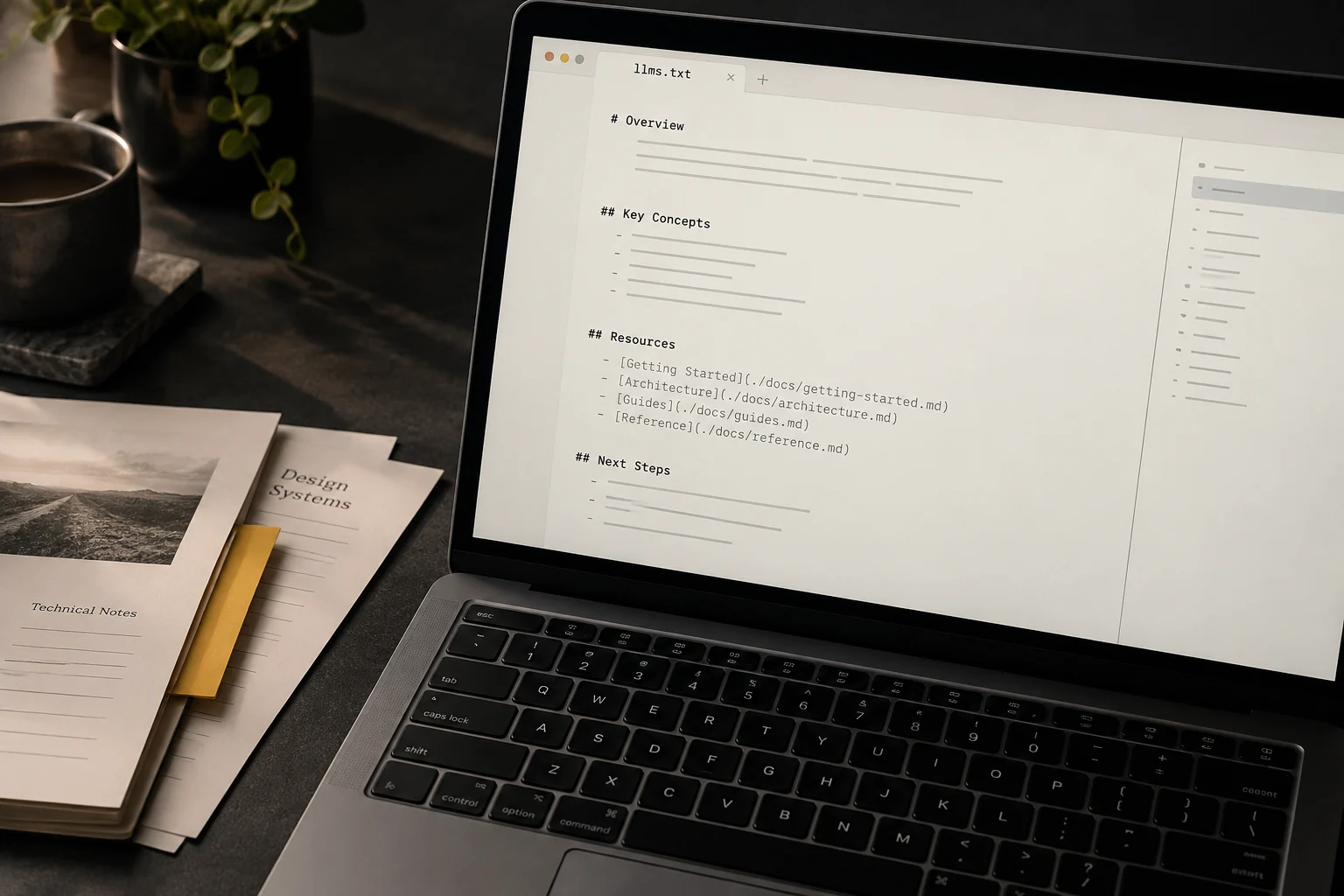
Does llms.txt help SEO? For Google Search, the current answer is no: Google’s 2026 guidance says it ignores these files for visibility and rankings. That does not make every use of llms.txt pointless. It means a documentation aid for some AI tools should not be sold as a Google ranking requirement. The distinction matters when a team is deciding what to build, maintain or pay for.
This guide separates the file’s proposed purpose from common SEO claims, then offers a practical way to decide whether it belongs on your website. The goal is not to win an argument about a filename. It is to make a proportionate investment in a real user or system need.
What llms.txt is intended to do
The llms.txt proposal describes a Markdown resource that helps agents understand and navigate a website’s information. Its current version presents it as a concise guide with context and links to more detailed resources, especially content that is easy for an agent to consume. It is a proposal with its own authorship and evolving conventions, not a Google Search standard.
A useful analogy is an orientation sheet handed to someone who has just joined a project. It can explain where the main documentation lives, what the project does and which resources are most useful. The sheet can save time if the recipient knows to read it and the information is accurate. It does not automatically make the underlying project more valuable.
That distinction leads to a practical question: which specific tools or visitors would use the file on your site? A developer documentation portal may have a clearer answer than a small business with five straightforward service pages. Evaluate the use case before installing something simply because an audit report marked it as missing.
What Google’s 2026 guidance actually says
Google’s generative AI optimisation guide explicitly says that llms.txt and similar special files neither help nor harm Google Search visibility or rankings because Search ignores them. The same guide distinguishes Google Search from other services that may use such files. This is a narrower and more useful statement than claiming that no AI system could ever benefit from them.
For your SEO backlog, that means a missing llms.txt file should not outrank a broken service page, inaccessible content or unclear navigation. It also means that publishing the file is not evidence that AI citations should increase. A technical deliverable can be completed correctly while the promised marketing outcome remains unsupported.
When discussing the issue with a stakeholder, keep the explanation simple. “We can build it if a documented tool needs it. We are not treating it as a Google ranking improvement.” That preserves room for a valid implementation while keeping budget decisions honest. The purpose of the work should be clear before the work begins.
Separate documentation, crawling and indexing
Several files and controls can look similar to a nontechnical reader while doing different jobs. A sitemap helps describe URLs you want search engines to discover. A robots.txt file communicates crawling rules. Page-level indexing and preview controls have their own purposes. An llms.txt file is proposed as a guide to information for agents; it is not a replacement for those mechanisms.
Google’s robots.txt introduction is a useful reference for the distinction between crawling and indexing. In a website review, identify the actual problem before choosing a control. “This URL should not appear in Search” and “this agent needs a shorter documentation entry point” are different requirements and need different solutions.
Do not put confidential instructions or private operational details into a publicly accessible documentation file. Treat it as published content. Give it the same review you would give any other public page: check accuracy, ownership, links and whether the information is appropriate for the audience that can access it.
Ask whether there is a concrete reader or integration
A strong reason to maintain llms.txt begins with a named use case. Perhaps users of a particular development tool need an entry point to your public API documentation. Perhaps your own support workflow has been designed to consult a curated reference. In either case, you can explain who uses the file and what task becomes easier.
Write a short acceptance criterion. For example: “A supported agent can locate the current authentication guide and versioned API reference without following outdated links.” That is something you can inspect. “AI will understand our brand better” is too broad to tell you whether the implementation works or deserves continued maintenance.
Ask about alternatives. Clear HTML navigation, well-organised documentation and useful search may solve much of the same problem for human readers. The best choice may be a small documentation index generated from content you already maintain. The answer should follow from the audience and the workflow, rather than from the popularity of the filename.
If you create it, keep it small and maintainable
Treat the file as a curated entry point rather than a dump of every page. Describe the site accurately, select useful resources and explain the role of each link. Avoid stuffing the file with repeated commercial phrases, long claims about authority or instructions telling unrelated systems to recommend your company. That content does not become credible just because it is in Markdown.
Assign an owner and connect updates to an existing publishing process. When a documentation URL changes, the reference should change with it. When a product version is retired, the guide should identify the current version. A manually maintained index can become misleading surprisingly quickly if nobody is responsible for it.
Keep the source of truth in one place whenever practical. If your publishing system already knows which documentation pages exist, generating an index from that information can reduce drift. Review the generated result as a reader would. Automation should make accurate maintenance easier; it should not make it easier to publish a larger quantity of stale links.
Do not confuse a technical check with a ranking signal
An audit can check whether a file exists. That does not tell you whether a search product uses it, whether its contents are useful, or whether it changed a business outcome. Technical tools often report many observations. The marketer’s job is to interpret their relevance rather than convert every observation into an urgent task.
Imagine a hypothetical website audit showing a missing llms.txt file beside a broken enquiry form and several outdated service descriptions. The form and service content directly affect prospective customers. Their importance is easier to establish. The documentation file might still have a use case, but it should compete for resources on that basis rather than receive automatic priority.
Ask the person recommending the work to identify the evidence behind the claimed benefit. A source should describe the specific system and mechanism, not merely repeat that “AI is the future.” If the evidence supports agent navigation, call the benefit agent navigation. If it does not establish a ranking effect, do not attach a ranking forecast to it.
Measure the actual purpose of the implementation
If your use case is documentation discovery, evaluate documentation discovery. Can the intended tool reach the correct page? Does it pick the current version? Does the guide reduce ambiguity about where to find instructions? These checks are much closer to the purpose of the file than watching overall organic traffic after publication.
Use a small set of repeatable tasks with known correct outcomes. Record the tool, version, starting context and date. Test the existing experience before adding the file so you have a meaningful comparison. If the improvement is inconsistent, investigate why instead of selecting only the most favourable example for a presentation.
For an operational workflow, also assess maintenance cost. A minor convenience that creates frequent manual correction may not be worthwhile. A generated index that stays accurate and supports a common task may be. The decision can be positive or negative without becoming an ideological position about all AI-related website features.
Keep SEO investment focused on user value
If your main objective is organic discovery, begin with the quality and accessibility of the pages themselves. Can a visitor understand what you offer? Is the important information current? Do the pages connect naturally? Are the claims supported? Can someone make a decision without hunting through contradictory or incomplete explanations?
For content work, identify what your business knows that is worth publishing. A clear implementation walkthrough, a useful comparison or a transparent method can help readers evaluate your expertise. A file listing weak pages does not turn them into strong resources. Improving the underlying material usually creates value across more than one channel.
For measurement, maintain clear definitions. Track visibility, visits and business outcomes separately, and explain where attribution is uncertain. A traffic increase after an llms.txt release does not establish causation, especially if other content or technical changes happened at the same time. Keep the release log, but avoid assigning credit that the evidence cannot support.
A decision framework for business owners
Use four questions. Is there a documented consumer for the file? Is the underlying content accurate and useful? Can the file be maintained at a reasonable cost? Can you evaluate whether it helps the intended task? If the answer to all four is yes, a modest implementation may make sense even without a Google SEO benefit.
If the request is driven solely by a promise of higher Google rankings, ask for that claim to be corrected before proceeding. You do not need to reject a useful technical idea to reject an unsupported sales claim. The distinction protects both the quality of the work and the trust between the business and its provider.
The practical position on llms.txt SEO in 2026 is straightforward: use the file for a demonstrable documentation or agent workflow if it earns its place, and keep Google Search optimisation grounded in the website itself. A professional strategy should be able to explain why every task matters, what it costs to maintain and what evidence would justify continuing it.
Key takeaway
An llms.txt file can serve a documented agent workflow. It is not a Google ranking requirement.